Suppose we have two strings — how do we measure how "similar" they are? For example, between naxt and exnt, which one is more similar to next? To answer this, we need a unified criterion.
To establish such a unified criterion, someone proposed the concept of 编辑距离 (Edit distance or Levenshtein distance).
What is edit distance? As the name suggests, it's the number of edits required to transform string a (source) into string b (target). Each edit can only add / delete / replace one character. Computing the minimum edit distance from a to b gives us a measure of the similarity between the two strings.
When string a and string b are identical, the edit distance is 0; the greater their differences, the larger the edit distance.
How It Works
In general, computing the edit distance uses a two-dimensional array of size a's length × b's length as the computation area, and applies 动态规划 (Dynamic Programming, DP for short) to solve it.
The specific steps are:
- Build an m×n matrix, where m = len(a) + 1, n = len(b) + 1. Thus the 2D array covers matrix[0...n-1][0...m-1].
- Assign matrix[0][0...m-1] the values 0...m-1, and assign matrix[0...n-1][0] the values 0...n-1.
- Traverse matrix[1...n-1][1...m-1], setting each element's value to:
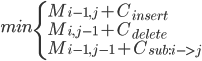
Here and are both fixed values (you can set them to 1, 2, or whatever you like). And is the value that needs to be evaluated. When and are equal in value, is 0; otherwise is a predefined weight.
Finally, the value of matrix[n-1][m-1] is the minimum edit distance between the two strings.
Improvement When and have the same value, the value of SUBSTITUTE_COST is 0, which is necessarily the minimum. So we first check whether the two characters are equal; if they are, we can directly set matrix[i][j]=matrix[i-1][j-1] and move on to the next one. This saves a great deal of computation.
Implementation
Predefinitions
The weights for the insertion operation (INSERT_COST), the deletion operation (DELETE_COST), and the substitution operation (SUBSTITUTE_COST) can all be defined as you see fit. Here I use preprocessor definitions to set them to 1, 1, and 2 respectively. But there are actually other approaches, such as defining them as variables.#ifndef INSERT_COST
#define INSERT_COST 1
#endif // INSERT_COST
#ifndef DELETE_COST
#define DELETE_COST 1
#endif // DELETE_COST
#ifndef SUBSTITUTE_COST
#define SUBSTITUTE_COST 2
#endif // SUBSTITUTE_COSTUtility Macro
The principle has already been explained: we need to find the minimum of three values, so a macro can be used directly to accomplish the task of "getting the minimum of three values." Unlike recursion, macro definitions incur very little overhead, so you can use them without any concern.#ifndef _MIN
#define _MIN(x,y,z) ((x<y)?((x<z)?x:z):((y<z)?y:z))
#endif // _MIN(x,y,z)Main Logic
int editDistance(const char *t,const char * s) //compare target && src
{
	int m = strlen(s)+1; // length of source + 1 for j in 0,1,2...m
	int n = strlen(t)+1; // length of dest + 1 for i in 0,1,2...n
	int matrix[n][m];// distance matrix
	int i;
	int j;
	for(i = 0 ; i < n ; i ++)
	{
		memset(matrix[i],0,m*sizeof(int));
		matrix[i][0] = i;
	}
	for(i = 0 ; i < m;i++) matrix[0][i] = i;
	for(i = 1 ; i < n ; i ++ )
	{
		for(j = 1 ; j < m ; j ++)
		{
			if(t[i-1] == s[j-1])
			{
				matrix[i][j] = matrix[i-1][j-1];
			}else
			{
				matrix[i][j] = _MIN(matrix[i][j-1] + INSERT_COST, // insert cost
						matrix[i-1][j] + DELETE_COST, // delete cost
						matrix[i-1][j-1] + SUBSTITUTE_COST); // substitute cost
			}
		}
	}
	return matrix[n-1][m-1];
}
Extensions
The highlighted part on L18 is exactly the check for whether the characters t[i-1] and s[j-1] are equal. If we have any special requirements, we can tamper with this spot. For example, suppose we want 'a' and 'b' to be treated as the same thing. Then we write a predicate function
inline int isSame(char a, char b)
{
	return (a<b?(a=='a'&&b=='b'):(a=='b'&&b=='a'))|| a==b;
}
and modify L18 to
if(isSame(t[i-1],s[j-1]))
Comments · 1